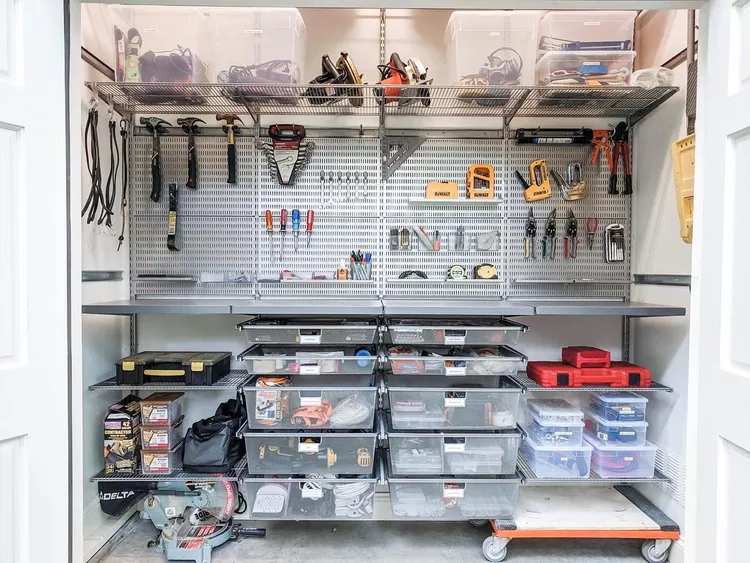
Cordless tools become frustrating when charged packs, depleted batteries, chargers, and adapters are scattered across a workshop. Good tool battery storage ideas keep compatible components together, protect electrical contacts, and provide a clean charging location without allowing cords and accessories to overrun the workbench.
Keep Batteries Organized by Tool Platform
Group battery packs according to the tools and chargers they fit. Similar-looking batteries from different systems can easily become mixed when they’re stored in one undivided drawer.
A labeled shelf or compartment makes identification faster. Keep spare adapters or platform-specific accessories in the same general area without covering battery terminals.
Separate Charged and Waiting Batteries
A simple two-zone system can reduce guesswork. One section can hold batteries ready for use while another holds packs waiting for charging or inspection.
Homeowners developing workshop organization systems can use this visual separation without installing complicated cabinetry.
Build a Dedicated Charging Area
Chargers work best when they aren’t buried under tools, sawdust, rags, or loose hardware. Give them a stable surface with enough room around them for normal ventilation according to the manufacturer’s instructions.
Route cords so they aren’t stretched across walkways or sharp edges. A nearby outlet can reduce the temptation to create a permanent tangle of extension cords.
| Item | Storage Approach | Main Benefit |
|---|---|---|
| Battery packs | Labeled shelf | Easy identification |
| Chargers | Open charging station | Keeps cords together |
| Adapters | Small divided bin | Prevents loss |
| Manuals | Folder or drawer | Keeps references handy |
Protect Battery Contacts and Housings
Don’t let loose screws, drill bits, nails, or other conductive metal objects share direct contact with battery terminals. Keep batteries in their designed housing or a dedicated compartment where terminals aren’t exposed to miscellaneous hardware.
Packs should also be protected from impact. Stacking heavy tools on top of batteries may damage housings or make cracks difficult to notice.
General garage storage approaches can be adapted so batteries occupy a cleaner section away from bulky mechanical equipment.
Keep the Area Dry and Temperature-Aware
A dry indoor workshop or suitable utility area is generally easier on batteries and chargers than locations exposed to moisture or extreme temperature swings. Follow the battery manufacturer’s storage instructions for the specific chemistry and product.
Avoid locating a charging station beside sinks, leaking pipes, outdoor doors that admit rain, or areas where flammable debris accumulates. Keep the surrounding surface uncluttered enough that damaged equipment can be noticed quickly.
Ideas from practical home workspaces can also help separate charging tasks from cutting, sanding, or other messy work.
Where Tool Battery Organization Fails
A beautifully labeled station still fails if every charger requires unplugging another device or if battery packs are stacked three rows deep. Accessibility should drive the layout.
Another mistake is assuming every battery should remain permanently connected to a charger. Charging and long-term storage recommendations vary by manufacturer and battery system, so the product manual should guide that decision.
Discarding damaged lithium-ion batteries with ordinary household trash may also be inappropriate. Follow local battery recycling or hazardous-waste rules and the manufacturer’s guidance.
Frequently Asked Questions
Can cordless tool batteries be stored in the garage?
They may be stored in a suitable garage if conditions stay within the manufacturer’s recommended temperature and moisture limits. Garages subject to extreme heat, freezing conditions, water intrusion, or heavy humidity may require a different storage location.
Should tool batteries stay on the charger between uses?
That depends on the charger and battery system. Some chargers are designed to manage connected batteries, while other manufacturers provide different storage recommendations. Follow the instructions supplied with your specific equipment.
How should damaged tool batteries be handled?
Stop using packs that are swollen, cracked, leaking, unusually hot, or otherwise visibly damaged. Keep them away from combustible materials and follow the manufacturer’s instructions and local battery disposal or recycling requirements.
Keep the Power System Under Control
Treat cordless batteries and chargers as one system instead of scattered workshop accessories. Group compatible packs, protect their contacts, maintain a clear charging space, and follow manufacturer guidance for storage and charging. A disciplined setup saves time at the workbench while making damaged, depleted, or misplaced components much easier to identify.